


MU JIAN · YLANG-YLANG
FULLER FLORAL SWEETNESS · SOFT AGARWOOD
A softer, rounder floral scent built on the same agarwood base as the rest of the MU JIAN series.
Ylang-ylang brings the fullest floral presence of the four. Its sweetness feels soft and rounded rather than sharp, while the agarwood underneath keeps the scent warm and grounded.
As it burns, flower and wood overlap rather than separating into obvious stages, leaving a warm woody finish with a lingering floral sweetness.
Scent structure: Agarwood · Ylang-Ylang
Net weight: 6 g
Stick count: Approx. 34 (typically 29–39)
Stick length: 21 cm
Diameter: 1.5 mm
Burn time: Approx. 32 minutes per stick
Approx. total burn time: 15.5–21 hours
Each tube is hand-filled by net weight. As the sticks are handmade, their thickness and density vary slightly, so the exact count and total burn time may differ from tube to tube.
Couldn't load pickup availability
Made in Qingyuan, Guangdong, China
View full details


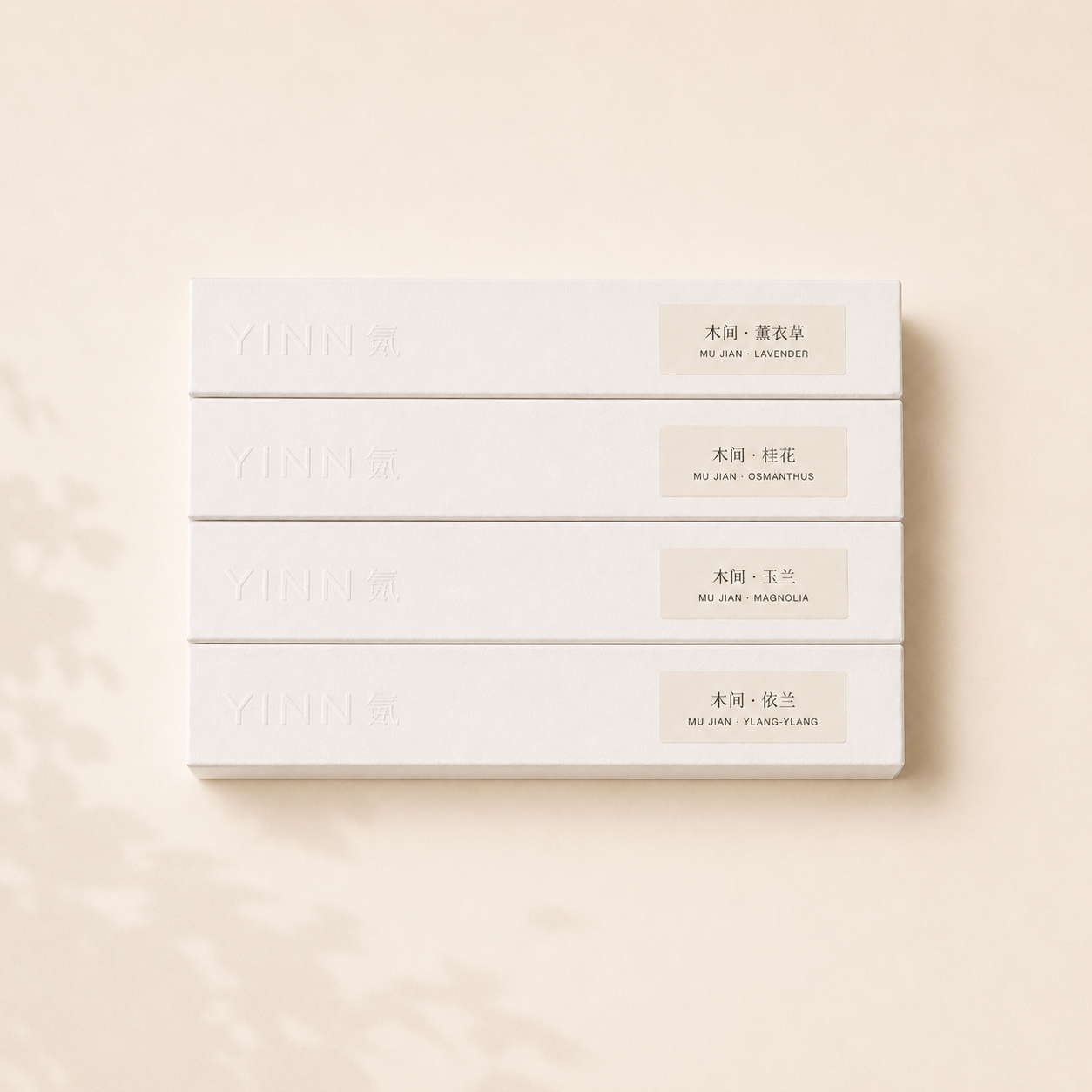
A Fuller Ylang-Ylang Floral Incense Grounded by Agarwood
MU JIAN · YLANG-YLANG is the roundest and fullest floral expression in the MU JIAN series. Ylang-ylang brings warmth and body to the opening, while the agarwood underneath keeps the fragrance grounded and prevents the floral sweetness from becoming overly perfumed.
As the incense burns, the flower and wood remain closely connected. The ylang-ylang softens the edges of the agarwood; the agarwood, in return, gives the floral note depth and steadiness. The result is warm, rounded and gently enveloping rather than bright or sugary.
Choose this incense when you want more floral presence than Magnolia or Lavender, but still want wood to remain part of the experience. For a brighter and more expansive flower-led alternative, explore OSMANTHUS IN FULL BLOOM.
The blend begins with a prepared agarwood base, giving the fuller ylang-ylang note a clean and balanced foundation.
Start with flowers. Discover agarwood
MU JIAN is built on one agarwood foundation, opened in four different ways through osmanthus, magnolia, ylang-ylang and lavender.
The flowers change the character. Agarwood remains the foundation.
A foundational wood of Chinese incense
Across historical Chinese incense formulas, agarwood appears again and again — in court incense, incense for garments, pressed incense and many kinds of He Xiang.
It is one of the foundational aromatic woods of the Chinese incense tradition.
Traditional materia medica also understood agarwood beyond scent alone, using expressions such as “clearing the spirit” and “harmonising qi and spirit.”
Agarwood today
Modern research has identified a complex aromatic composition in agarwood, including sesquiterpenes and 2-(2-phenylethyl)chromones.
Research also continues to explore agarwood aroma in relation to sleep, calm states and nervous-system activity.
Centuries of traditional use and modern research approach the same material in different ways — and both continue to deepen how we understand it.
Before it enters the blend, we prepare the agarwood first
Agarwood can carry raw, sharp or uneven notes depending on the material.
Before blending, our incense maker prepares it through Fei Shui (飞水), a water-treatment process adjusted to the condition of each batch.
The purpose is not to add another scent. It is to reduce rawness, sharpness and unwanted notes, so the agarwood becomes cleaner, softer and more rounded before entering the formula.


Four flowers. Four characters
More than scent: Wei & Qi
Wei (味) is what the nose perceives. Qi (气) is the character of an aromatic material as it moves through the air and meets the person living with it.
In Chinese incense culture, aromatic materials have long been understood not only by scent, but also by qualities such as warm or cool, rising or settling, opening or gathering. These ideas come from the same tradition of materia medica that looks at how plants interact with the body and a person’s state.
This is also close to the Chinese idea of yang (养) — to support and nourish over time. The aim is not a dramatic immediate effect, but to choose aromas whose qualities feel in harmony with the person, so they can be lived with comfortably and beneficially over the long term.
In He Xiang, materials are therefore blended for both Wei and Qi. A scent may smell woody and bittersweet, yet feel warm and gently opening; another may smell floral, yet feel quiet and settling.
YINN chooses and recommends incense by both what you smell and how you want to feel.
Natural materials. Handmade form

YINN incense is made from natural aromatic materials and shaped by hand.
- Natural woods, herbs, resins and flowers
- Fine, slender incense sticks
- A relatively light incense body, allowing the aromatic materials to express themselves as they burn
- Handmade — slight curves and small variations are natural
- Natural colour varies with each formula
- Many materials can still be smelled before the incense is lit
- Made for scent and burn quality, not visual uniformity
How One Stick Is Made
Traditional He Xiang is made through a sequence of distinct stages. Drying is not the end — the incense still needs time to settle before it is ready.
-
Sorting & Cleaning
Woods, herbs, resins and flowers are selected, cleaned and prepared before they enter the formula.
-
Pao Zhi (炮制)
Different materials are treated differently. Depending on the material, this may include soaking, steaming, boiling, roasting or drying to prepare it for blending.
-
Grinding & Sieving
Each prepared material is ground separately and sieved to the fineness required by the formula.
-
Blending & Kneading
The powders are weighed according to the maker’s formula, blended with water and natural plant binder, then repeatedly kneaded and allowed to rest.
-
Shaping & Shade-Drying
The rested incense dough is formed into fine sticks and slowly dried in a shaded, ventilated environment.
-
Resting & Cellar Ageing
Drying is not the final step. The finished incense is rested and cellar-aged — traditionally described as qu xing (去性) and jiao cang (窖藏) — until the newly made incense has settled further.
How to Use the Box
The packaging box converts into an incense holder, so no separate holder is required. It stores and protects the sticks before use, supports the incense while it burns, and helps contain fallen ash. Place it on a stable, heat-resistant surface, keep the room ventilated, and never leave burning incense unattended. Keep away from children, pets and flammable materials.

Set the holder
Open the box and place the fixing piece into its position inside the box.

Insert and light
Insert one stick into the metal holder. Light the tip, then gently blow out the flame and allow the glowing ember to burn.

Let it finish naturally
The ash falls directly into the box. When the burning incense reaches the metal head, it extinguishes naturally. Allow the ash and holder to cool completely before emptying the box.
Learn why we designed the incense box to become the holder →