
The Scent of Frankincense in Chinese Blended Incense
Frankincense is often associated with churches, smoke, and a deep resinous smell. But the raw material itself can be much brighter than that impression suggests.
Frankincense usually smells bright, resinous and pine-like, often with citrus-peel freshness and a warm, gently sweet base. When burned directly, it can become smokier and heavier. In Chinese blended incense, preparation and blending can make the aroma smoother, softer and more integrated.
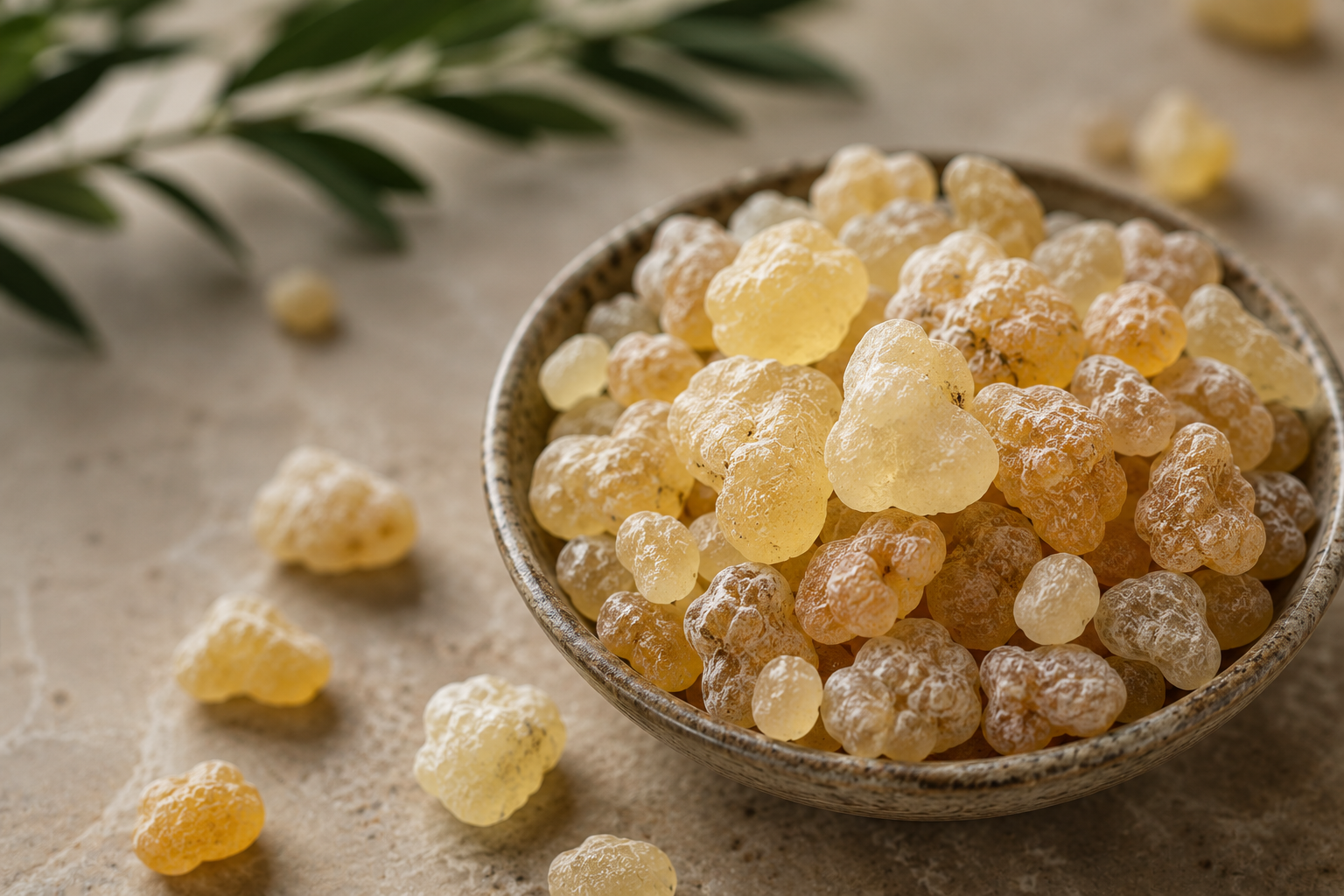
Good frankincense can carry a fresh, pine-like quality, a lift that feels close to lemon or citrus peel, and a warmer resinous sweetness underneath. Research on Boswellia sacra has identified key odorants including α-pinene, β-myrcene and linalool. Omani frankincense is also known for bright citrus-like facets, although the aroma varies by resin grade, origin and preparation.
It is not one fixed smell. Origin, the resin itself, and what happens to it when heated all change what reaches your nose.
Raw Resin, Direct Burning, and Blended Incense
| Form | What shapes the experience | Typical impression |
|---|---|---|
| Raw frankincense resin | Origin, grade and the resin itself | Bright resin, pine, citrus peel and warm sweetness may be noticeable |
| Resin burned directly on charcoal or high heat | Heat intensity and proximity to concentrated smoke | Heavier smoke, charred or bitter edges can cover the brighter notes |
| Prepared Chinese blended incense | Material preparation, woods, herbs, proportion and stick combustion | The resin can feel smoother and more integrated into a complete scent |
These are useful distinctions, not fixed guarantees. Origin, material quality, preparation and burning method can change every form.
Why Does Frankincense Smell Smoky or Burnt?
This is where frankincense can become confusing.
Someone may describe it as fresh and citrusy, while your own experience is smoky, heavy or even slightly burnt. Both can be true.
Frankincense is a resin. Once it is heated or burned, you are no longer smelling only the aroma of the raw resin. You are also smelling what heat does to it.
In sensory work on burning Boswellia sacra, citrus was still one of the strongest characteristics, but smoky and burned notes appeared alongside pine-like and spicy qualities. Some assessors also described the burning resin as strong, heavy or intense.
That means a dark, smoky experience is not necessarily the full character of frankincense. It may be one way the material expresses itself under heat.
This distinction matters especially if your first encounter with frankincense was a piece of resin placed directly over charcoal. The resin is concentrated in one place and receives intense heat. The result can be beautiful, but it can also be powerful.
Chinese blended incense approaches the same material differently. The difference is easier to understand when we separate smoke from the aroma released into the air.
How Does Frankincense Change in Chinese Blended Incense?
Traditional Chinese incense making does not begin with the assumption that an aromatic material should simply be burned exactly as it arrives.
Materials are prepared according to their own character.
Frankincense is a good example. It is a sticky resin that softens with heat and is not naturally easy to grind. As with other materials discussed in Chinese incense and traditional materia medica, preparation matters. In the Chen Shi Xiang Pu (《陈氏香谱》), frankincense has its own preparation entry. The text records methods for making the resin easier to pulverize, including gently warming it while wrapped in paper before grinding. Elsewhere in traditional formulas, frankincense is repeatedly instructed to be ground separately before it joins the rest of the blend.
That may sound like a small technical detail, but it changes something important.
Instead of one concentrated piece of resin receiving heat on its own, finely prepared frankincense can be dispersed throughout woods, herbs, spices and other aromatic materials. When the finished incense burns, those materials release together.
Traditional incense texts then go further. The goal of blending was described as allowing the different aromatics to become “one body”, without one simply covering another. Newly blended incense could also be rested or yin (窨), allowing the materials to settle into each other before use. The Chen Shi Xiang Pu describes this as their aromatic characters gradually “entering into one another.”
This is also a useful way to understand the role our incense maker describes for frankincense: fixing and integrating the blend.
That does not mean frankincense loses its own character. Its warmth, brightness and resinous body are still there. But instead of standing apart as one strong piece of burning resin, those qualities can spread through the whole scent.
A spicy material can feel less isolated. Wood can become warmer and fuller. Sweetness can feel less like a separate note. The transitions become smoother.
For the person in the room, that is the important part.
The process changes not only what goes into the incense, but what frankincense finally feels like in the air.
Two Ways We Use Omani Frankincense
We use Omani frankincense in both versions of Hua Yue Ye, but the two blends give very different experiences.
Hua Yue Ye · Mellow|花月夜 · 初
Here, frankincense sits with clove, cinnamon, fennel, patchouli and other aromatics that each have a strong character of their own.
The finished scent, however, is not dominated by sharp spice or a heavy resin note. What comes through is warm wood, gentle sweetness and a light herbal freshness, with the different materials held together in a soft, continuous scent.
For someone interested in frankincense but unsure about a very strong resinous or smoky experience, this shows a gentler side of the material.
Hua Yue Ye · Full-Bodied|花月夜 · 满
Here, frankincense has a larger presence.
The scent feels fuller, and resin, sweetness, creamy warmth and fresh notes can appear and recede as the incense burns. There is more to notice, but the different parts still remain connected.
This is the richer of the two: better suited to someone who already enjoys resinous scents and wants frankincense to have more presence without experiencing it only as resin and smoke.
Which Frankincense Experience Might You Prefer?
If you prefer warm woods, gentle sweetness and a softer resinous presence, start with Hua Yue Ye · Mellow.
If you prefer a fuller frankincense presence, with more sweetness, depth and changing layers, choose Hua Yue Ye · Full-Bodied.
Frankincense has a character of its own. But how it is prepared, blended and burned can reveal very different sides of the same material.
That is part of what makes frankincense so interesting—and part of what Chinese blended incense can bring to it. You can also use our Scent Guide to compare softer, warmer and more resinous profiles, or read how Chinese incense moves from smoke to scent.
Explore Hua Yue Ye · Full-Bodied →
Frequently Asked Questions
What does frankincense smell like?
Frankincense usually smells resinous, pine-like and fresh, often with citrus-peel brightness, warm wood and a gentle sweetness. Its exact character varies by species, origin, resin grade and the way it is heated.
Does frankincense smell like church incense?
It can, but church incense is often a blend and is commonly burned over charcoal. Direct high heat creates a stronger smoky impression. Raw frankincense and Chinese blended incense can reveal brighter, softer and more integrated aspects of the resin.
Why can burning frankincense smell smoky or burnt?
When resin receives intense heat, you smell both its natural aromatic compounds and the products created by heating or combustion. That is why the same frankincense can seem citrusy and pine-like in one setting, but smoky, heavy or burnt in another.
What is Omani frankincense?
Omani frankincense is resin harvested from frankincense trees in Oman, especially Boswellia sacra. Different harvests and grades vary, but many show bright pine, citrus and warm resin characteristics.
What is the difference between frankincense resin and frankincense incense?
Frankincense resin is the raw aromatic gum collected from the tree. Frankincense incense may use that resin alone or combine prepared frankincense with woods, herbs and spices. The blend and heating method strongly affect what you smell.
Sources & Further Reading
- Identification of odorants in frankincense (Boswellia sacra)
- Phytochemical analysis of Omani Boswellia sacra oleogum resin
- Chemical differentiation of Boswellia sacra and Boswellia carterii essential oils
- Chen Shi Xiang Pu (《陈氏香谱》), traditional preparation entries and incense formulas concerning frankincense.