


HUA YUE YE · MELLOW
MELLOW WOODS · SOFT SWEETNESS · A LIGHT HERBAL TRACE
Many aromatics. One new scent.
A warm, softly sweet Chinese blended incense in which many distinct aromatic materials are brought into one continuous scent.
Omani frankincense, clove, cinnamon, fennel, Huoxiang (藿香) and Jinyanxiang each begin with very different characters. In the finished incense, however, their individual edges soften into something that feels almost like a naturally sweet piece of warm wood.
The sweetness is gentle rather than sugary. A faint herbal trace returns underneath, keeping the scent clean and balanced. The result is not a list of recognizable notes, but one mellow scent that seems to have grown as a whole.
Core aromatic materials: Omani Frankincense · Clove · Cinnamon · Jinyanxiang · Fennel · Huoxiang (藿香)
Net weight: 8 g
Stick count: Approx. 22 (typically 20–24)
Stick length: 21 cm
Diameter: 1.8 mm
Burn time: Approx. 45 minutes per stick
Approx. total burn time: 15–18 hours
Each tube is hand-filled by net weight. As the sticks are handmade, their thickness and density vary slightly, so the exact count and total burn time may differ from tube to tube.
Couldn't load pickup availability
Made in Qingyuan, Guangdong, China
View full details

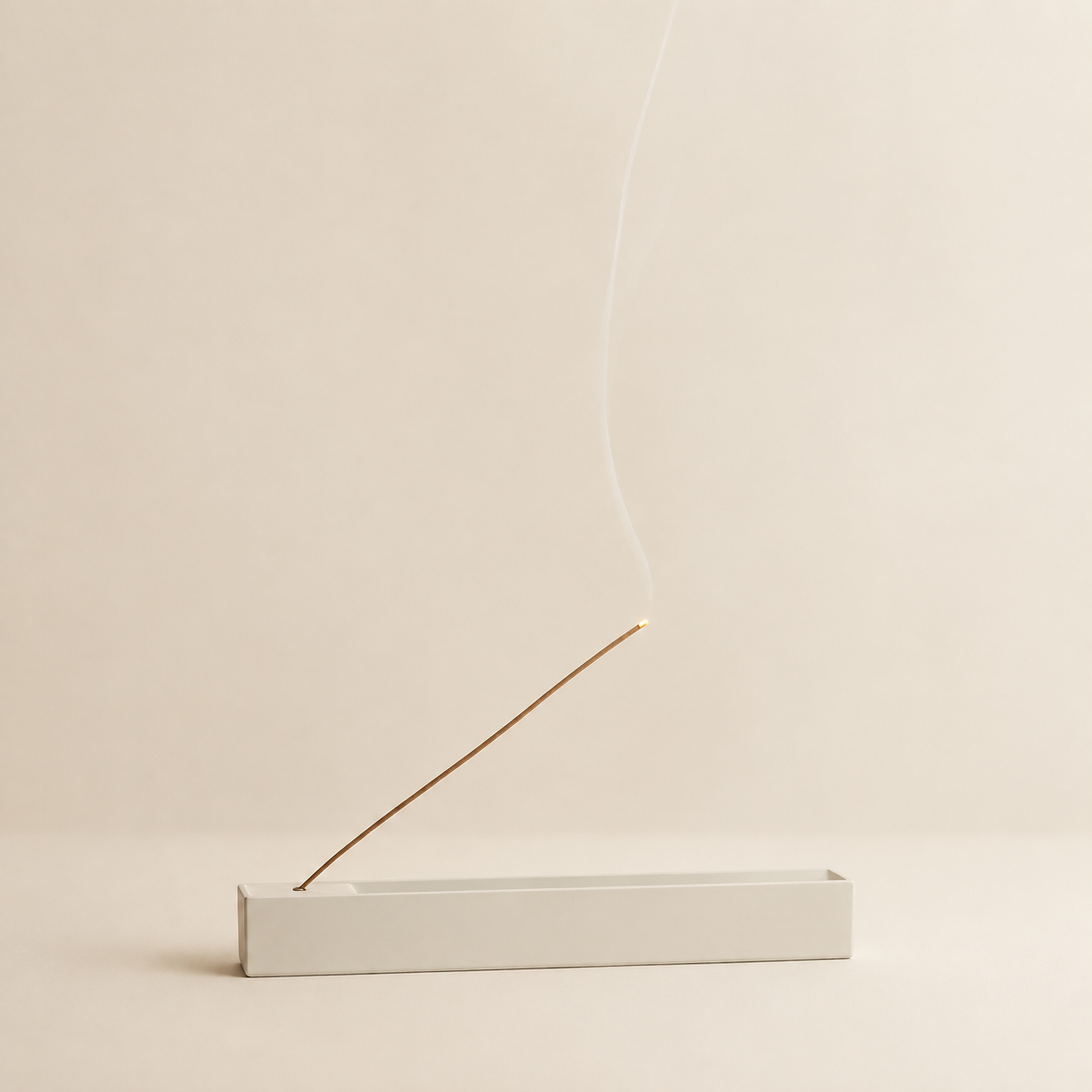
A Mellow Frankincense Incense with Warm Woods
HUA YUE YE · MELLOW brings Omani frankincense, warm spices, woods and herbs into a composition with softened edges. Instead of asking each material to stand apart, the formula lets them meet gradually and form a new, rounded scent.
Warm woods provide the centre. Frankincense adds resinous depth, while clove, cinnamon and fennel contribute gentle warmth and a restrained sweetness. A faint herbal trace appears around the edges, keeping the blend aromatic without making it feel sharp or medicinal.
This is the quieter expression of the HUA YUE YE pair. It stays warm and cohesive, with fewer dramatic changes than FULL-BODIED. Choose it if you prefer incense that settles into a room softly and does not ask you to identify every note. For a stronger, more layered composition, compare it with HUA YUE YE · FULL-BODIED.
If warm woods are the part you enjoy most, WARM HERBAL WOODS offers a drier and more distinctly herbal direction.
What Makes YINN Incense Different
YINN makes He Xiang — Chinese blended aromatics, following traditional Chinese incense-making techniques preserved through China’s intangible cultural heritage. Traditional medicinal incense-making follows the principle of Jun–Chen–Zuo–Shi (君臣佐使), combining aromatic materials according to their different properties and relationships rather than simply layering pleasant smells.
Chinese tradition does not understand natural materials through scent alone. It also considers warmth and coolness, rising and settling, opening outward or gathering inward. Processing and blending can further change how these qualities are expressed.
This gives He Xiang another dimension beyond what something simply smells like.
Wei (味) is what you smell. Qi (气) is how the incense feels to live with.
A scent may smell woody and bittersweet, yet feel warm and gently opening. Another may smell floral, yet feel quiet and settling. This is why YINN recommends incense not only by scent preference, but also by the person, their current state, and the kind of scent that may feel more comfortable at that moment.
Many historical formulas once relied on rare and expensive materials available only to a small part of society. Today, makers have access to a much wider range of aromatic materials. What matters is preserving the xiang yun (香韵) — the character that makes a formula worth remembering — while adjusting materials, proportions and burning form so more people can enjoy that scent in everyday life.
Good He Xiang is not only something you smell. It is something you live with.

Natural materials. Handmade form.
- Natural aromatic materials
- Fine, slender sticks
- Relatively light in density, allowing the aromatic materials to express themselves more fully as they burn
- Handmade — slight curves and variations are natural
- Natural colours vary with each formula
- Wood, herbs, resins or flowers can often be smelled even before lighting
- Made for scent and burn quality, not machine-perfect uniformity
How One Stick Is Made
Traditional He Xiang is made through a sequence of distinct stages. Drying is not the end — the incense still needs time to settle before it is ready.
-
Sorting & Cleaning
Woods, herbs, resins and flowers are selected, cleaned and prepared before they enter the formula.
-
Pao Zhi (炮制)
Different materials are treated differently. Depending on the material, this may include soaking, steaming, boiling, roasting or drying to prepare it for blending.
-
Grinding & Sieving
Each prepared material is ground separately and sieved to the fineness required by the formula.
-
Blending & Kneading
The powders are weighed according to the maker’s formula, blended with water and natural plant binder, then repeatedly kneaded and allowed to rest.
-
Shaping & Shade-Drying
The rested incense dough is formed into fine sticks and slowly dried in a shaded, ventilated environment.
-
Resting & Cellar Ageing
Drying is not the final step. The finished incense is rested and cellar-aged — traditionally described as qu xing (去性) and jiao cang (窖藏) — until the newly made incense has settled further.
How to Use the Box
The packaging box converts into an incense holder, so no separate holder is required. It stores and protects the sticks before use, supports the incense while it burns, and helps contain fallen ash. Place it on a stable, heat-resistant surface, keep the room ventilated, and never leave burning incense unattended. Keep away from children, pets and flammable materials.

Set the holder
Open the box and place the fixing piece into its position inside the box.

Insert and light
Insert one stick into the metal holder. Light the tip, then gently blow out the flame and allow the glowing ember to burn.

Let it finish naturally
The ash falls directly into the box. When the burning incense reaches the metal head, it extinguishes naturally. Allow the ash and holder to cool completely before emptying the box.
Learn why we designed the incense box to become the holder →